Dissecting pump curves:
Does adding a VFD to a pump change the size and shape of the efficiency contours (or efficiency islands)?
Adding a VFD (Variable Frequency Drive) can change the size and shape of the efficiency contours, but not because the pump itself changes — it's because you're now operating that same pump at multiple speeds, and each speed has its own set of pump and efficiency curves.
When you add a VFD, the pump gets multiple curves. Each speed (e.g., 60 Hz, 50 Hz, 40 Hz) produces a different Curve and a different efficiency profile. So you no longer have one fixed efficiency contour — you have a family of curves, each with its own BEP and efficiency islands.
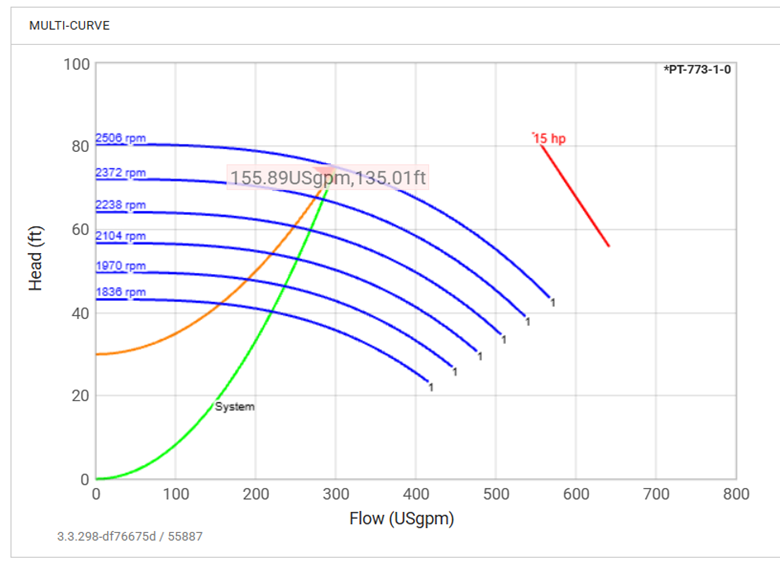
Efficiency shifts with speed. As speed decreases the BEP shifts to lower flow rates, and overall pump efficiency tends to drop, especially at very low speeds.
You get more flexibility — but also complexity
The benefit of a VFD is that you can match pump output to varying system demand, improving system-level efficiency (even if the pump’s own efficiency drops a bit at lower speeds). A VFD provides more operating flexibility, but it doesn't magically make the pump efficient at all speeds. For best results, systems should be designed so that the pump operates near its BEP across the expected speed range of the VFD.
On a pump curve diagram, what are the u-shaped lines? And what do they mean?
These are lines that connect points on the curve where the pump operates at the same efficiency. Each U-shaped line represents a constant efficiency level — for example, 60%, 70%, 80%, etc. The center of the U-shaped contours is the Best Efficiency Point (BEP) — this is where the pump operates most efficiently (e.g., 82–90% for many centrifugal pumps). As you move away from that center in either direction (lower or higher flow), efficiency drops.
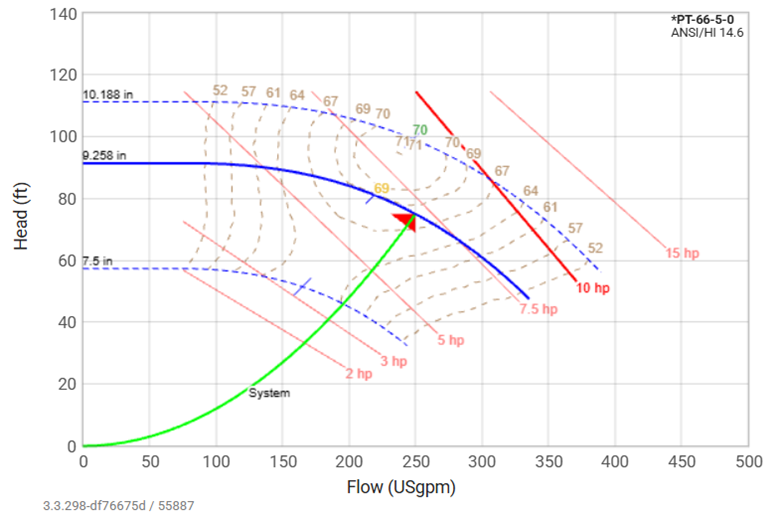
These contours help engineers choose pumps that will operate near their BEP most of the time, ensuring:
- Lower energy consumption
- Less wear and vibration
- Longer pump life
Selecting a pump that regularly operates near the center of one of the higher efficiency islands (ideally around the BEP) means better performance and lower operating costs.
What does it mean to say a pump is “off its curve”? How can a pump be off its curve? Doesn't that just mean the pump curve was drawn improperly?
It’s worth examining the meaning of the phrase because it can be confusing. When someone says a pump is operating "off its curve," they usually mean that the actual performance of the pump (flow rate and head) does not match what is predicted by the manufacturer’s pump curve. But this doesn’t mean the curve was drawn incorrectly. Instead, it typically indicates that the pump is being operated in a condition outside its expected parameters. So how can a pump be “off its curve”?
There are a few possible reasons:
System conditions have changed
The pump curve is only valid for a specific impeller diameter and speed. But the actual operating point is where the pump curve intersects the system curve. If the system has changed (clogged filters, partially closed valves, longer pipe runs) the system curve shifts, and the pump’s actual flow/head moves along its curve, away from the originally expected spot.
Pump wear or damage
Impeller erosion, increased internal clearances, or motor problems can degrade pump performance, to the point that a pump is no longer delivering flow/head that matches the original curve.
Air entrainment or cavitation
If air is getting into the system or the pump is cavitating, performance drops and the pump can appear to be off its curve.
Improper measurement
Flow or pressure measurements could be inaccurate due to sensor error or poor placement, leading to the impression the pump is under- or over-performing.
What does closing a valve do to pump performance? And how would that performance change show up in the pump curve drawing?
Closing a valve (typically on the discharge side of a pump) affects pump performance by changing the system curve — not the pump curve. As you close the valve, you restrict flow. This adds head loss to the system, steepening the system curve (more head required for a given flow rate). The system curve rotates upward (gets steeper) as the valve closes. The pump will still follow its own curve, but the new system curve intersects it at a different point that reflects a lower flow and higher head. You’re not changing the pump’s capabilities — you're just moving where it operates on its curve.
Understanding Pump Curves and VFDs:
Pump Curves:
These curves illustrate the relationship between a pump's flow rate and the pressure it generates at different speeds.
VFDs and Pump Curves:
VFDs enable pumps to operate at various speeds, effectively creating a family of pump curves instead of just one.
System Curves:
A system curve represents the resistance of the piping system (friction and static head). The intersection of the pump curve and the system curve determines the pump's operating point.
VFD Benefits:
VFDs allow pumps to adjust their speed to match changing system demands, optimizing performance and energy consumption.
Energy Savings: By reducing pump speed when flow demand is low, VFDs can significantly decrease energy consumption.
Flow Control: VFDs provide precise flow control, allowing pumps to deliver the exact amount of fluid needed without wasting energy or creating excessive pressure.
Reduced Wear and Tear: By avoiding constant full-speed operation, VFDs can extend the lifespan of pumps and other system components.
How VFDs Affect Pump Operation:
Constant Pressure Systems:
In systems where constant pressure is needed despite varying flow, VFDs can adjust pump speed to maintain the desired pressure, even as flow demands change.
Friction-Dominated Systems:
VFDs are particularly effective in systems where friction losses are a major factor, as they can efficiently adjust to changing friction with speed variations.
Steeper vs. Flatter Pump Curves:
Pumps with steeper pump curves generally offer greater potential for energy savings with VFDs, as a small change in speed can lead to a significant change in flow.
Hydronic Pump Balance Using Variable Speed Drive with No ...
In essence, VFDs enhance the flexibility and efficiency of pumping systems by allowing pumps to operate along a range of curves, adapting to varying flow and pressure needs.
Recent articles highlight the increasing adoption and importance of Variable Frequency Drives (VFDs) in HVAC systems for improved energy efficiency and precise control. VFDs, also known as adjustable frequency drives, offer significant benefits by allowing motors to operate at variable speeds, matching the system's needs dynamically. This leads to reduced energy consumption, quieter operation, and extended equipment lifespan.
Here's a breakdown of key points from recent articles:
Benefits of VFDs in HVAC:
Energy Efficiency:
VFDs significantly reduce energy consumption by allowing motors to run at optimal speeds based on demand, rather than full speed all the time.
Precise Control:
VFDs provide precise control over motor speed, leading to better temperature and airflow management, enhancing comfort and reducing wear and tear on equipment.
Reduced Maintenance:
By minimizing motor stress and enabling smoother operation, VFDs can contribute to reduced maintenance needs and longer equipment lifespan.
Quieter Operation:
VFDs can help minimize noise and vibration, creating a more comfortable environment.
Meeting Regulations:
VFDs are crucial for meeting environmental regulations like the F-Gas and Eco Design Directive, especially in refrigeration systems.
Specific Applications:
VFDs are utilized in various HVAC components like pumps, fans, and compressors.
Recent Developments:
Invertek Drives is showcasing its Optidrive range, including the Coolvert for BLDC compressors and the Optidrive Eco for various HVAC applications, at the AHR Expo.
Mitsubishi Electric Automation
released its F800 series VFD, designed for a wide range of applications including HVAC.
ABB
highlights the energy savings potential of VFDs in cooling tower fans, where speed control can be effectively implemented based on water temperature.
Eaton
offers VFDs for various applications, including HVAC, with options for ultra-compact solutions, clean power, and future configurability.
Considerations:
Proper Installation and Configuration: Recent articles also emphasize the importance of proper installation and configuration of VFDs to avoid performance issues and unnecessary energy costs.
VFD Life Span: ASHRAE recommends a VFD life span of 10-12 years.
Potential Failure Points: Extreme bus faults and high starting currents are mentioned as potential causes of VFD failure.
Hot water recirculating pumps can experience several issues, including noise, leaks, reduced efficiency, and failure to operate. Common problems include a faulty bypass valve, power supply issues, worn-out bearings, and leaks due to worn-out seals or loose screws. Regular maintenance, including cleaning and inspection, is crucial for optimal performance and longevity.
Common Issues and Troubleshooting:
Noise:
Humming, grinding, or other unusual noises can indicate worn-out bearings or other mechanical issues within the pump.
Leaks:
Leaks can occur due to damaged O-rings, loose screws, or worn-out gaskets.
Low Flow Rate:
A low flow rate can result from a small motor, a faulty bypass valve, or blockages in the pipes.
Failure to Operate:
A pump that won't turn on or stay on could be due to power supply issues, wiring problems, or internal component failures.
Bypass Valve Issues:
A faulty bypass valve can disrupt water flow and cause the pump to operate inefficiently.
Troubleshooting Steps:
- Check the power supply:
Ensure the pump is properly connected to a working power source and that the circuit breaker is not tripped.
- Inspect for leaks:
Look for any signs of water leaks around the pump and its connections. Tighten loose screws or connections, and replace any damaged seals.
- Listen for unusual noises:
If you hear noises coming from the pump, it may be a sign of worn-out bearings or other mechanical problems.
- Check the bypass valve:
Make sure the bypass valve is functioning correctly and not stuck in a closed position.
- Ensure proper water flow:
Check for any blockages in the pipes that may be restricting water flow.
- Consider the pump's age and condition:
If the pump is old or has not been properly maintained, it may be time for a replacement.
Recent issues with water pressure booster systems often involve noise, pump failures, and pressure fluctuations. These can stem from problems with the pump itself, the system's plumbing, or even the water source. Common causes include clogged filters, air leaks, malfunctioning pressure switches, and outdated pump technology.
Specific Problems and Solutions:
Noise:
Older pumps, especially those with fan-cooled motors, can be noisy. Poor pump control (e.g., running constantly when not needed) or improper installation can also cause vibrations and noise.
Pump Failure:
A pump may not start due to electrical, mechanical, or operational issues. It may also fail to shut off due to leaks, a faulty pressure switch, or incorrect settings.
Low or No Pressure:
This can be caused by clogged filters, air leaks, or a pump that's too small for the system's needs.
Fluctuating Pressure:
This can be a sign of a pressure switch issue, a leak in the system, or a pressure tank that needs adjusting.
Troubleshooting Steps:
- Check for leaks:
Inspect the entire system for any signs of water leaks, especially around fittings and connections.
- Inspect the pressure switch:
If the pump is short-cycling or not turning on/off correctly, the pressure switch may need to be adjusted or replaced.
- Clean or replace filters:
Clogged filters restrict water flow and can cause pressure issues.
- Check for air leaks:
Air leaks in the suction line can cause the pump to lose prime or operate inefficiently.
- Ensure proper pump size:
If the pump is undersized for the system's demand, it may not be able to maintain adequate pressure.
- Consult a professional:
If you are unable to identify or fix the problem yourself, it's best to consult a qualified plumber or pump technician.
If you configure 2 pumps in series, does that double the head?